




Changing Clubs, Not Leaving the Course: Rethinking Home at The Evelyn in Mt Ommaney

In golf, the course stays the same, but the way you play it changes. Distance, terrain and timing all call for different choices as the round unfolds. That idea sits neatly behind The Evelyn, a new retirement community taking shape beside the McLeod Country Golf Club in Mt Ommaney, at a time when many Australians are quietly rethinking what home should look like later in life.


Across the country, that rethink is already underway. National research shows that 26 per cent of people over 55 have already moved into housing better suited to how they live today, while another 29 per cent are actively considering it. Data also shows that one in five Australians over 65 requires help with property maintenance.

When the Family Home Stops Fitting

Against this backdrop, downsizing has steadily become something closer to recalibration. Ease of living, reduced upkeep and flexibility now rank ahead of financial pressure as reasons older Australians consider a move.

Like changing clubs mid-round, it is less about starting again and more about adjusting approach. People are not necessarily seeking smaller lives, but homes that allow them to stay active and connected, without the physical and mental load that can come with maintaining a large family property.

Evelyn and a Different Way of Living

Set within a golf course environment, The Evelyn reflects that shift in practical ways.

Residents live independently in private apartments and townhouses, while maintenance across homes and shared spaces is handled within the village. An on-site Village Manager and a 24-hour response system provide support when needed, without intruding on daily routines.

Photo Credit: Aura Holdings

Shared facilities are designed to be used naturally rather than formally programmed. Residents can join activities, socialise casually or simply keep their own rhythm. Like a clubhouse, the spaces are there to support connection without obligation.

Photo Credit: Aura Holdings

The development comprises 126 residences, including apartments and townhouses, delivered in stages.

Photo Credit: Aura Holdings

Designed by Marchese Partners | Life 3A, the community includes landscaped outdoor areas, a pool, gym, library, wine room and billiards room, all set within the grounds of the golf course.

Photo Credit: Aura Holdings

Shared facilities and communal areas are designed to be used naturally rather than programmed heavily. They offer a place to gather, linger or pass through, depending on the day. Connection is available, not compulsory.

The Role of Golf Beyond the Game

Golf’s presence here is not incidental. Golf courses, by their nature, act as large, stable green buffers within suburban environments. They offer visual openness, reduced noise and opportunities for restoration that are increasingly recognised as important for mental health.

While not everyone plays, research increasingly points to golf environments as supportive of healthy ageing in broader ways. Studies examining golf participation among older adults have found that the activity often delivers moderate-intensity physical movement, particularly walking, alongside cardiovascular and musculoskeletal benefits. Even when played at a lower intensity, golf has been shown to produce short-term improvements in cardiovascular profiles among older participants.

Golf at The Evelyn
Photo Credit: Aura Holdings

What matters just as much is the social and environmental context. Golf courses function as ready-made walking networks and social landscapes. People walk the fairways, meet others at the clubhouse, or simply move through open green space as part of daily routines. The Evelyn’s location within the McLeod Country Golf Club places residents adjacent to that ecosystem, whether they play the game or not.

The benefits of this setting extend beyond activity alone. A growing body of research, including Australian longitudinal studies, has linked exposure to green space with better mental health outcomes. More recent research focusing on mid-to-older adults has strengthened the evidence, showing associations between access to public green space and improved mental wellbeing over time.

The Evelyn’s proximity to the McLeod Country Golf Club taps into that reality, embedding the community within an active, established setting rather than isolating it from the surrounding suburb.

That everyday rhythm matters as people get older. Familiar places, regular movement and casual interaction are often what sustain wellbeing over time.
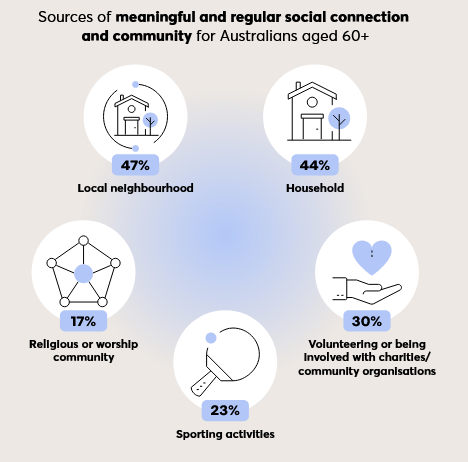
Infographic from Meaningful Aging Australia

McLeod Country Golf Club President Diane Lally said the partnership was about more than development. “The Evelyn represents more than a new retirement community — it represents the long-term sustainability of the McLeod Country Golf Club. This partnership allows us to strengthen our future, maintain a premier course, and continue to serve our members and the wider community.”
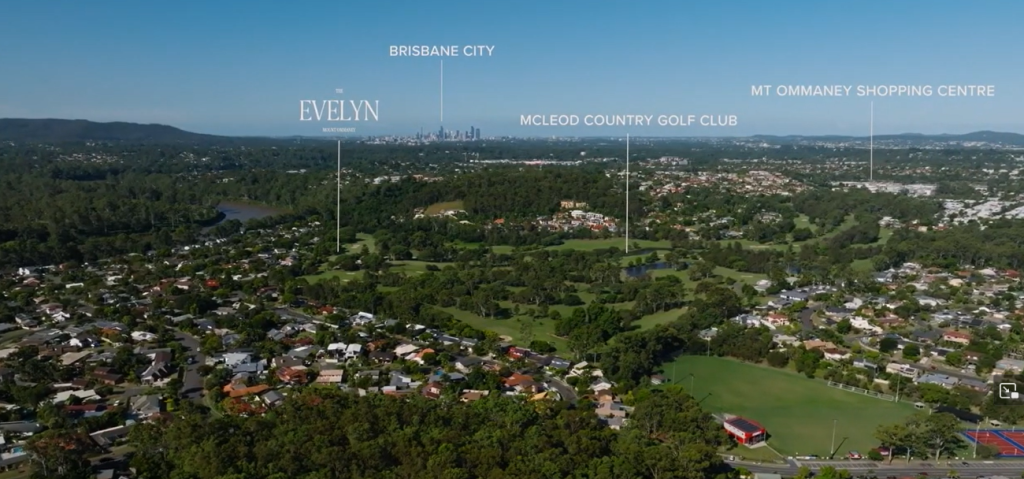
The Evelyn in Mt Ommaney

Housing That Supports How People Live

Research into retirement living models suggests that where and how people live can influence how active and socially engaged they remain. Communities designed around accessibility and shared space tend to support regular movement and interaction, while reducing some of the practical pressures of home ownership.

By reducing barriers to physical activity and
providing access to fitness and recreational facilities,
retirement communities help residents remain
approximately 15 per cent more frequently active
than those living independently in the community.
Residents are also 20 per cent less likely to be
hospitalised after entry.

Better Housing for Better Health (Retirement Living Council)

Mt Ommaney itself offers a balance many retirees value. Established parklands, river views and shopping centres sit alongside strong transport links to the Brisbane CBD. For long-term locals, staying close to familiar places often matters as much as changing how they live.

The Evelyn allows for that continuity. It offers an option to remain within the same neighbourhood while adapting housing to better suit changing needs. It is a shift in position rather than a change of course.

Who Is Behind The Evelyn?
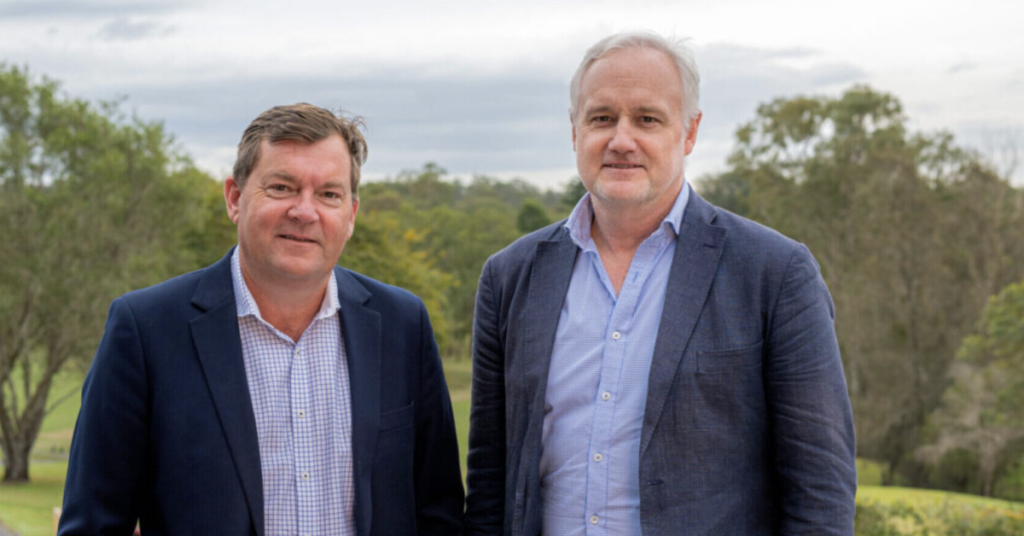
Tim Russell and Mark Taylor of Aura Holdings
Photo Credit: Aura Holdings

The Evelyn is owned and operated by Aura Holdings, a Brisbane-based retirement living company founded by Tim Russell and Mark Taylor. The company’s approach is informed by professional experience and personal perspective, with both founders having parents living in communities they operate.

The Evelyn will set the benchmark for retirement living in Brisbane, delivering modern apartments, strong community connections, and a premier golf club setting, unlike anything else in the Centenary suburbs,” Aura Holdings Chief Executive Officer Sean Graham said.

“We are pleased to see … the community’s confidence in both the project and Aura’s commitment to the ongoing partnership with the McLeod Country Golf Club,” he added.


Playing the Long Game

Not everyone will choose this path, and many Australians will continue to age in place. What is changing is the range of options available and the way people think about them.

Golf at The Evelyn
Photo Credit: Aura Holdings

The Evelyn reflects a broader shift in mindset. Life does not narrow as priorities change. It simply calls for a different approach. And sometimes, staying in the game means recognising when it is time to change clubs, not courses.

The Evelyn has emerged within that moment, amidst a gradual shift rather than a rush. People are not abandoning the course, they are choosing a different club to use.

Published 2-January-2026.


Aura Holdings is a proud Promotional Partner of Brisbane Suburbs Online News

This article explores broader trends in housing and ageing and does not constitute health or lifestyle advice.

Uncharted Waters: The Top 10 Moments of John Oxley’s Historic 1823 Expedition to the Brisbane River

Did you know that 2023 will mark 200 years since the historic 1823 expedition of John Oxley to the Brisbane River, a venture that shaped the future of Queensland? Here are the top 10 moments that shaped the course of John Oxley’s journey and the future of Brisbane and its surroundings.


1. The Mission is Set (1823)

In 1823, Governor Brisbane presented John Oxley with a daunting task: to locate a suitable site for a penal colony for the most stubborn convicts. This mission set Mr Oxley on a path that would forever change the landscape of Australian exploration. 

Embarking on this journey, Mr Oxley was poised to uncover new territories and possibilities, venturing into what was then uncharted Australian territory. This expedition wasn’t just a geographical exploration; it symbolised a significant step in the colonial expansion and understanding of Australia’s vast landscape​​.

Who was John Oxley?

John Oxley was born on 1 Jan 1784 in Yorkshire, England. He joined the Royal Navy at a young age, embarking on a naval career that eventually led him to Australian waters. In 1802, Mr Oxley first arrived in Australia as part of a naval patrol, marking the beginning of his long-standing relationship with the continent.

By 1812, he had transitioned from his naval career to become the Surveyor-General of New South Wales, a role in which he excelled due to his keen interest in exploration and topography. His position as Surveyor-General placed him at the forefront of mapping and exploring the vast, unknown interiors of the Australian continent.

His other notable expeditions include his 1817 and 1818 journeys along the Lachlan and Macquarie Rivers, which were instrumental in expanding the European understanding of Australia’s inland regions. These expeditions faced significant challenges, including harsh terrain and the eventual realisation that the rivers did not lead to an inland sea, as many had speculated.

Mr Oxley is also remembered for his contributions to the agricultural development of Australia. He was instrumental in identifying and promoting fertile lands for cultivation, which aided in the colony’s expansion and self-sufficiency.

He was an advocate for the settlement and development of Australia. His reports and maps from his expeditions were invaluable in guiding future exploration and colonization efforts.

Mr Oxley’s health declined in the late 1820s, and he passed away on 25 May 1828 in Sydney. 

2. First Glimpse of the Tweed Valley

As Mr Oxley navigated the Tweed River and valley, he was struck by the area’s stunning natural beauty. The lush, rich valley, adorned with magnificent trees and the winding river, captivated him. His vivid descriptions in his reports and journals convey a sense of wonder and excitement that was palpable. 

This moment was not just about the beauty of the landscape; it was a crucial discovery that highlighted the potential for new settlements and the richness of the Australian terrain. Mr Oxley’s impressions of the Tweed Valley would later influence colonial perspectives on Australian geography​​. 

John Oxley lands in Tweed Valley
Photo Credit: NLA/The Border Star/1941

3. A Crucial Meeting at Moreton Island

The expedition took a pivotal turn when Mr Oxley encountered two escaped convicts living among Aboriginal people on Moreton Island. This unexpected meeting provided Oxley with invaluable local knowledge and guidance. It was a unique interaction that bridged cultural divides and proved crucial in navigating the local geography. 

These convicts led Oxley to one of his most significant discoveries, demonstrating how chance encounters can alter the course of history​​.

4. The Brisbane River is Named (December 1823) 

Guided by the escaped convicts, Oxley discovered and named the Brisbane River in honour of Governor Thomas Brisbane. This act of naming was not just a formality but a significant colonial gesture, marking the river as an important geographical and administrative landmark.

Governor Thomas Brisbane
Photo Credit: Wikimedia Commons

Who was Gov Thomas Brisbane?

Sir Thomas Brisbane was a British Army officer and colonial administrator, born on July 23, 1773, in Ayrshire, Scotland. He served as the Governor of New South Wales from 1821 to 1825, a period marked by significant administrative reforms and expansion of the colony’s scientific and astronomical knowledge. Mr Brisbane was instrumental in promoting exploration and the development of infrastructure in the colony, including the establishment of a new currency.

John Oxley Names Brisbane River
Photo Credit: NLA

The naming of the Brisbane River was a key moment in the expedition, cementing Mr Oxley’s role in the European exploration of Australia and setting the stage for future settlements in the area​​​​.

5. The Strategic Decision at Wacol (3 December 1823) 

On 3 Dec 1823, Mr Oxley made a strategic decision to land and turn back at Wacol. This decision, whilst seemingly minor, was a critical juncture in the expedition. It demonstrated Mr Oxley’s ability to assess and respond to the challenges of exploration. This moment at Wacol marked not only a turning point in the expedition but also laid the groundwork for future exploratory efforts and settlements in the region​​.

6. Climbing Mount Ommaney

The ascent of Mount Ommaney was a key navigational and observational achievement for Mr Oxley. From this vantage point, he gained critical insights into the landscape’s layout, enhancing his mapping of the region. 

This moment was not just about the physical act of climbing but also about the broader perspective it offered. Mr Oxley’s observations from Mount Ommaney helped in understanding the region’s potential for settlement and navigation, furthering the colonial objectives of the expedition​​.

Oxley's memorial in Mt Ommaney
Photo Credit: Monument Australia

7. Rejoining the Mermaid (5 December 1823)

Reaching the Mermaid, their expedition vessel signalled the end of this exploration phase. This return was a moment of reflection and consolidation of the journey’s findings. The data and experiences gathered during this time were pivotal in shaping the future colonial policies and settlements. The journey back on the Mermaid marked the transition from exploration to the planning and execution of colonial expansion based on Mr Oxley’s findings​​.

8. Founding of Redcliffe (Post-Expedition)

The establishment of a convict settlement at Redcliffe, based on Mr Oxley’s recommendations, was a direct consequence of the expedition. This decision showcased the immediate and tangible impact of Mr Oxley’s exploration. Redcliffe’s founding represented a significant step in the colonial occupation and development of the region, a process that began with Mr Oxley’s mapping and exploration of the Brisbane River and its surroundings​​.

Redcliffe Memorial for Oxley
Photo Credit: Moreton Bay Library
Redcliffe Memorial for Oxley 2022
Photo Credit: Kerbray/Google Maps

9. The 1824 Follow-up Expedition

In 1824, John Oxley returned to the Brisbane River, accompanied by renowned botanist Allan Cunningham. This follow-up expedition allowed Mr Oxley to delve deeper into the region’s natural resources and potential for settlement. This journey was crucial in consolidating Mr Oxley’s findings from the previous year and further cemented his role in the development of the area. 

The 1824 expedition underscored the importance of continuous exploration and study in understanding and utilising Australia’s vast and varied landscape​​.

10. Oxley’s Lasting Impact on Brisbane

The city of Brisbane, as we know it today, owes much of its early development to Oxley’s exploratory efforts. His exploration and mapping of the Brisbane River laid the groundwork for the city’s formation. 


Mr Oxley’s journey went beyond mere discovery; it was instrumental in shaping the early urban and geographical identity of Brisbane. His legacy is a reminder of the crucial role that exploration and vision play in shaping the history and development of cities and regions​​.

Published 1-Dec-2023