




A Sherwood couple has completed a riverfront home designed for major flood events after repeated inundation on their long-held family block.
Background of Flooding and Site History
The Brisbane River has risen over the Sherwood property in several major events, including the floods of 1974, 2011 and 2022. The original home was affected in 2011, and the land was again inundated in 2022. During that 2022 event, a long stretch of the riverbank collapsed, causing parts of the block to sink by up to a metre. This resulted in earlier building approvals being withdrawn and required a complete redesign.

Richard and Janette Rowles returned to the Sherwood property after inheriting it in 2015. The couple had lived nearby for many years before deciding to rebuild on the riverfront despite its flood history.
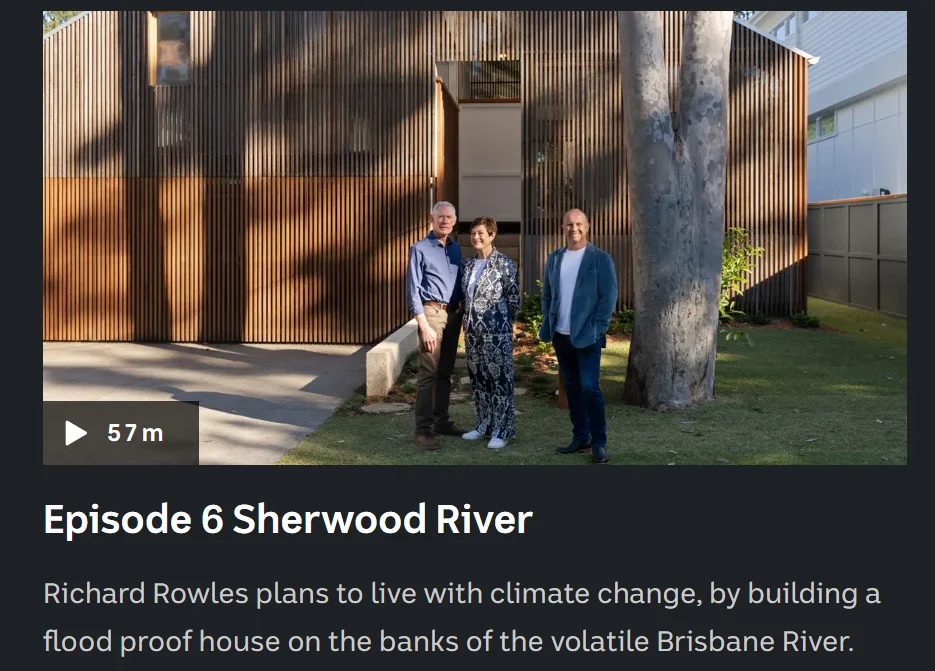
Photo Credit: ABC iview
Flood-Resilient Construction in Sherwood
The build took nearly two and a half years and cost more than $2 million. The new structure sits 11 metres from the river and almost half a metre above the council’s assessed flood level. It is supported by 26 piers embedded 13.5 metres into the ground, a measure intended to limit movement in any future landslip.

The lower level was intentionally designed to be submersible, with raised electrical points and switches. Living spaces were built on the upper floor, using water-resistant materials such as removable melamine wall panels, epoxy-painted steel framing and ironbark floorboards. A concrete staircase links the undercroft to a central courtyard and upper rooms.

Expert Insights and Design Principles
Flood-resilience specialist James Davidson notes that while the Sherwood example is a high-cost project, the principles applied can be used for new builds or retrofits at lower budgets. He highlights measures such as identifying projected flood levels, raising homes where possible, using resilient materials and positioning services above likely flood points.
He also recommends avoiding cavity construction, using concrete and tiled surfaces, treating pine framing and removing plasterboard in high-risk areas. He maintains that no house can be fully flood-proof, but these steps can reduce damage and recovery time.

Photo Credit: Wikipedia
Community Perspectives and Comparisons
Online discussion has shown mixed responses, with some residents pointing to similar raised designs and hose-out ground levels used in other flood-affected regions. Others reference the wide variation in past flood heights and the limits of designing for extreme events. Some discussions also mention floating structures and high-stilt housing as alternative approaches.


Future Implications for Riverfront Living
Although the Sherwood home incorporates extensive flood-resilience measures, expert commentary notes that increasing flood levels will continue to shape building decisions along the river. Some specialists indicate that relocating away from high-risk areas remains the only complete safeguard, though many homeowners are instead adopting resilience-based strategies.
Published 24-Nov-2025